
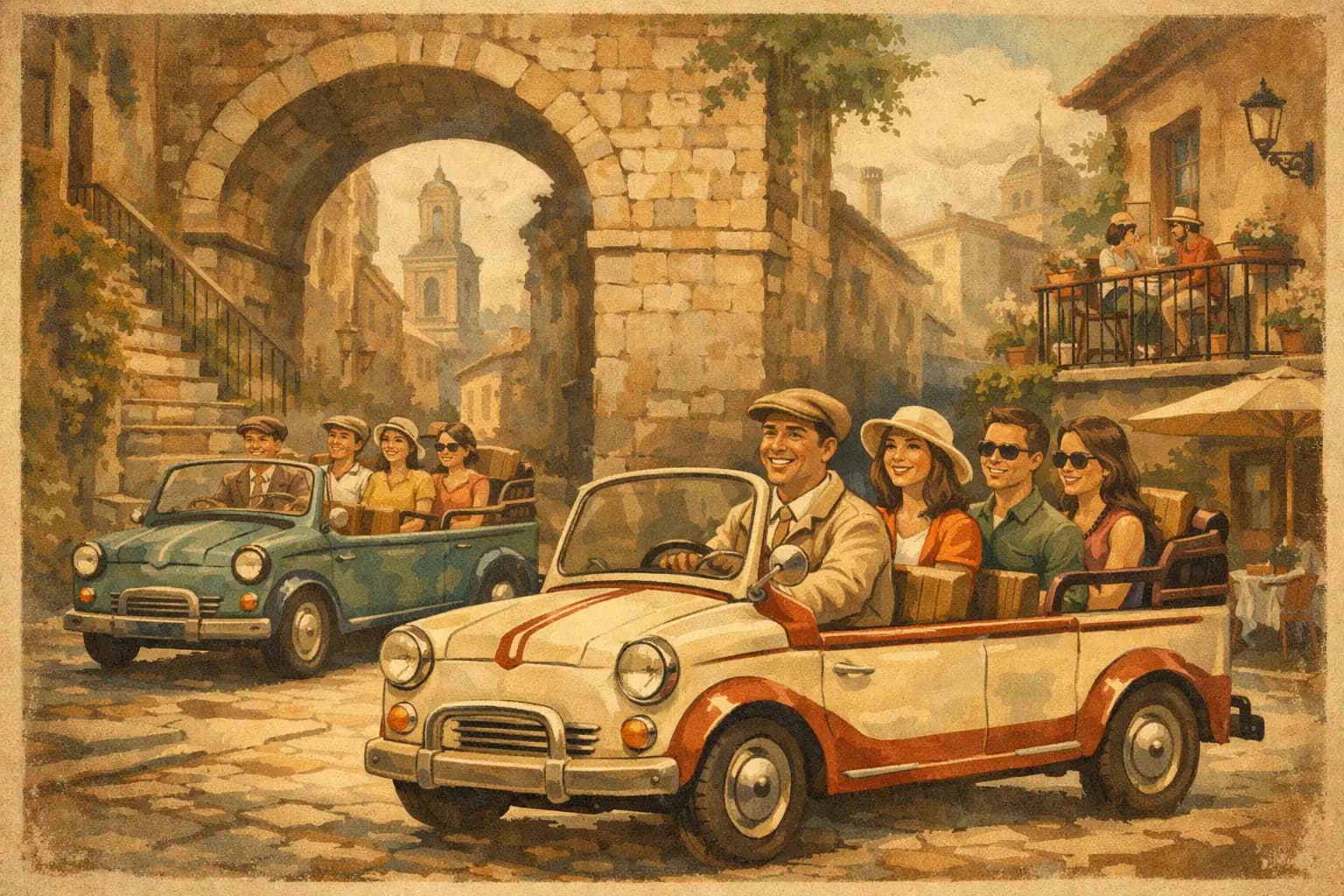
Find the best hidden places Madrid offers, from secret gardens and historic stations to intimate museums, for a more elegant city escape at an easy pace.
Madrid reveals itself differently from the back seat of a vintage car. Beyond the grand façades of Gran Vía and the familiar grandeur of the Royal Palace, the best hidden places Madrid holds are found behind garden gates, beneath old platforms, and in quiet corners where the city seems to lower its voice. These are places for travelers who prefer a story to a checklist - and who understand that the most memorable photographs are rarely taken in the busiest square.
12 Best Hidden Places in Madrid for a More Personal Visit
1. El Capricho Park
In the northeast of the city, El Capricho feels less like a public park and more like the private landscape of a vanished aristocratic estate. Created at the end of the 18th century for the Duchess of Osuna, its grounds hold a small temple, a lake, follies, sculpted hedges, and paths that seem designed for unhurried conversation.
It is particularly beautiful in soft morning light, when its theatrical details feel almost untouched by modern Madrid. Access is limited on certain days and the park is a little removed from the center, which is precisely why it remains so peaceful. It rewards guests who have time to make a graceful detour.
2. Quinta de los Molinos
For a few fleeting weeks in late winter and early spring, Quinta de los Molinos becomes one of Madrid’s most romantic scenes. Thousands of almond trees bloom in pale pink and white, creating an unexpected moment of countryside within the capital.
This is not a place to visit for certainty. The flowering season depends entirely on the weather, and its beauty lies in that unpredictability. For couples visiting at the right moment, a private stop here can feel like finding a secret season inside the city.
3. The Garden of the Prince of Anglona
Tucked behind the streets of La Latina, the Garden of the Prince of Anglona is one of old Madrid’s loveliest surprises. It is a formal 18th-century garden beside a noble residence, framed by ironwork, cypress, trimmed hedges, and the quiet dignity of a neighborhood that has seen centuries pass.
The garden itself is small, but it is best appreciated as part of an atmospheric passage through Madrid de los Austrias. Arrive after wandering the nearby lanes, and its stillness feels all the more deliberate.
4. Huerto de las Monjas
Near the lively streets around Plaza de la Paja, Huerto de las Monjas offers a glimpse of a Madrid few visitors notice. This secluded courtyard garden, associated with a convent, sits behind an unassuming entrance and retains the intimate scale of the old city.
Its appeal is not spectacle. It is the sensation of stepping away from the surrounding energy into a protected, almost private world. Opening access can vary, so it is best treated as a serendipitous stop rather than the centerpiece of a day.
5. Andén 0 at Chamberí Station
Below Madrid’s streets, the former Chamberí metro station preserves the elegance of a different era. Closed in the 1960s when platforms were extended for longer trains, it reopened as a museum space with original tilework, vintage advertisements, turnstiles, and the atmosphere of the early Metro.
Andén 0 is one of the city’s most cinematic hidden addresses. It is especially compelling for guests drawn to design, transport history, and the pleasure of seeing a familiar city from an unexpected angle. Check visiting hours in advance, as access is not always available.
6. Museo Cerralbo
The Museo Cerralbo is an intimate antidote to Madrid’s monumental museums. Housed in a 19th-century palace near Plaza de España, it presents the art, armor, clocks, porcelain, and furniture collected by the Marquis of Cerralbo in rooms that still feel richly inhabited.
Rather than moving through neutral galleries, visitors pass beneath painted ceilings and chandeliers, surrounded by the private taste of a cultured Madrid household. The experience is elegant, layered, and surprisingly personal - particularly for those who have already seen the Prado and seek a different scale of beauty.
7. Museo del Romanticismo
Set in a refined palace in the Chueca area, the Museum of Romanticism captures the mood of 19th-century Madrid with salons, portraits, pianos, fans, and period furnishings. Its rooms are beautifully composed without feeling overly formal, and the garden café provides one of the most civilized pauses in the center.
Choose this museum when the day calls for interiors rather than crowds. It suits travelers who notice fabric, light, and the small rituals that give historic houses their character.
8. The Royal Observatory of Madrid
Designed by Juan de Villanueva, the Royal Observatory sits quietly near Retiro Park, its neoclassical dome and scientific instruments recalling Madrid’s Age of Enlightenment. It is an exceptional choice for guests interested in architecture, astronomy, or the city’s intellectual history.
The observatory’s beauty is restrained rather than showy. Its setting offers a calm contrast to the park nearby, and its celebrated telescope adds a distinctly cinematic note. Visits and schedules can be limited, so this is a destination best arranged with intention.
9. San Antonio de la Florida
Many visitors know Goya through the Prado. Far fewer enter the modest chapel of San Antonio de la Florida, where his frescoes surround the dome in a startlingly immediate display of color and movement. The artist is buried here, making the experience both artistic and quietly ceremonial.
Located near the Manzanares River, the chapel is easily overlooked by those following the standard historic route. Yet it offers one of Madrid’s most direct encounters with Goya - intimate, atmospheric, and far removed from a crowded museum hall.
10. The Pantheon of Spain
Near Atocha, the Pantheon of Spain is a hushed monument dedicated to prominent figures from the country’s political and cultural past. Its ornate tombs, marble details, and Byzantine-inspired architecture create an almost dreamlike setting.
It is not a destination for everyone. Guests who prefer lively neighborhoods or contemporary energy may find it too solemn. But for those drawn to history and evocative architecture, it is one of Madrid’s most overlooked interiors and a remarkable place for reflective photographs.
11. La Ermita de la Virgen del Puerto
On the edge of the Madrid Río park, the Ermita de la Virgen del Puerto is a small baroque chapel with an unexpectedly tranquil setting. The surrounding slopes look toward the Royal Palace and the city beyond, offering a perspective that feels both local and grand.
This stop works beautifully in the late afternoon, when the river park softens into golden light. It can be paired with a scenic drive past the palace, Casa de Campo, and the Temple of Debod, creating a route that feels composed rather than rushed.
12. Palacio de Liria
Palacio de Liria remains one of Madrid’s great private residences, home to the House of Alba and a collection that includes works by masters such as Goya, Velázquez, and Rubens. Its formal rooms and gardens offer a rare view into aristocratic Madrid, with all the polish one would expect from a palace still connected to living history.
Reservations are essential, and the visit is more structured than a spontaneous garden stop. Still, for travelers who value heritage, art, and exceptional interiors, it is among the city’s most rewarding lesser-known experiences.
Let Madrid Set the Pace
The finest hidden places are not always the most obscure. Sometimes they are simply the places that become extraordinary when reached at the right hour, with the right route, and without the pressure of keeping up with a group. A private experience with Retro Tour Madrid can weave these quieter addresses between the city’s icons, with a tailored pickup from your hotel and time for the moments that deserve to linger.
Leave room in your itinerary for one unplanned turn. In Madrid, a shaded courtyard, an old tiled doorway, or a pause above the rooftops can become the part of the journey you remember most.
Prêt à explorer Madrid en Ford T ?