
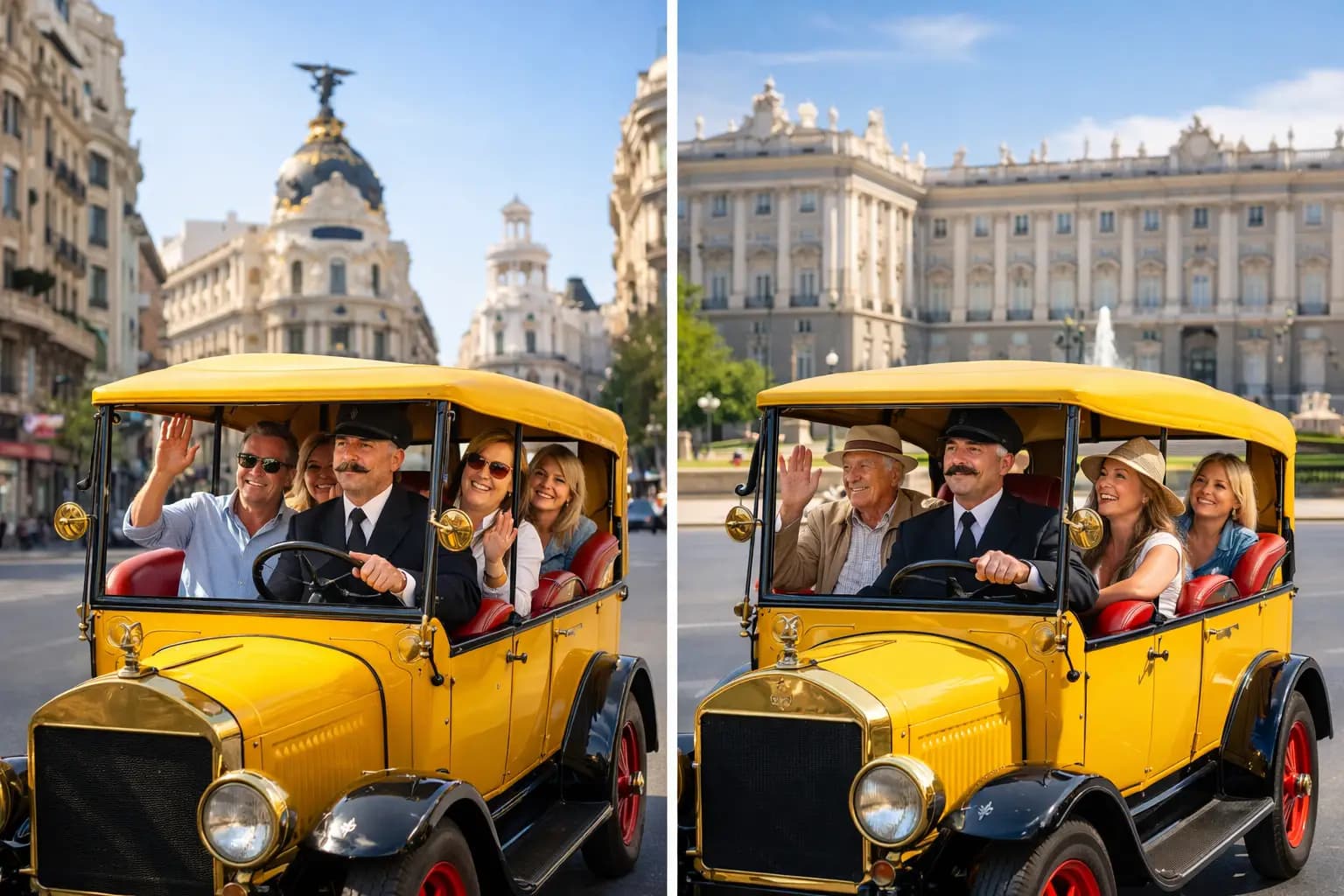
Recorrer Madrid con encanto means seeing hidden lanes, royal facades, and grand avenues privately, at an elegant pace made for lasting memories in Madrid.
Recorrer Madrid con encanto from old streets to grand boulevards
Begin where Madrid feels oldest. Madrid de los Austrias has a theatrical quality, with arcades, elegant squares, and streets that still carry the rhythm of the Habsburg court. Near the Royal Palace, the city opens into grand perspectives: ceremonial stone, landscaped viewpoints, and a calm that can feel surprising in the center of a European capital.
This is a wonderful area to see in the morning, before the streets fill. The Royal Palace district is not merely an essential stop for first-time visitors. It is also the setting for a more refined introduction to Madrid: the sweep of the palace walls, the dignified geometry of the nearby gardens, and the quieter corners that reveal the city’s older scale.
From there, La Latina changes the mood. Its lanes are less formal, more spontaneous, and full of small visual discoveries. A wrought-iron balcony, a weathered doorway, a market street coming to life. This neighborhood is best appreciated without a rigid schedule. The appeal is in turning down the street that looks promising and allowing a guide with local knowledge to recognize what is worth pausing for.
The Barrio de las Letras offers a different kind of romance. Once home to some of Spain’s greatest writers, it has a cultivated, lived-in charm. Its streets are ideal for travelers who enjoy history but do not want their day to feel like a lecture. Here, literary Madrid meets understated elegance: quiet boutique façades, traditional restaurants, and streets that become particularly atmospheric as evening approaches.
Lavapiés brings another dimension. It is more eclectic and multicultural, with a creative energy distinct from the classic grandeur of the royal quarter. It will not suit every guest in the same way, and that is precisely why a bespoke route matters. For travelers drawn to authentic neighborhood life, its markets, mural-covered corners, and cultural layers can be a revealing contrast to Madrid’s more polished avenues.
The Madrid of landmark views and elegant arrivals
Madrid’s modern elegance is inseparable from its boulevards. The route around Atocha, the Prado Museum, Neptune Fountain, and Cibeles Fountain is a sequence of landmarks that feels made for a vintage car. The city’s architecture becomes part of the journey rather than a series of stops separated by logistics.
The Metropolis Building and Gran Vía bring a touch of early twentieth-century glamour. Their façades are at their finest when the light begins to soften, while the movement of the avenue gives the scene its unmistakable energy. This is not the quiet Madrid of hidden courtyards. It is the capital at its most confident and cinematic.
Nearby, the Royal Botanical Garden and El Retiro Park offer a change of pace. The value of these places is not simply that they are beautiful. They give the day a breath of green between the city’s stone landmarks. A brief stop by Alcalá Gate, followed by a gentle drive along the park’s edge, can become one of those small, unplanned moments guests remember long after returning home.
For longer private itineraries, the city can widen further. The Santiago Bernabéu Stadium, Las Ventas Bullring, and the Temple of Debod each reveal a different Madrid. The stadium speaks to the city’s global sporting identity, Las Ventas to its traditions and complex history, and the Temple of Debod to Madrid’s gift for dramatic sunset views. The right choice depends on what you have already seen, what interests you, and whether the day calls for culture, architecture, or simply a beautiful final view.
Why the vehicle changes the experience
There is a difference between being transported through Madrid and arriving through it. A private vintage car creates anticipation before the first landmark appears. It brings the city into focus at a more graceful pace, while offering the comfort and privacy that discerning travelers expect.
The legendary 1920 Ford Model T has a presence that no standard vehicle can replicate. It is not simply a way to move between locations. It becomes part of the photographs, the conversation, and the feeling of the day. For an anniversary, proposal, honeymoon, or an exceptionally well-planned weekend in Madrid, that distinction matters.
There are practical considerations, too. Central Madrid has streets where large vehicles feel intrusive and walking distances can become tiring, especially in warmer months. A private route can balance close access to historic districts with comfortable transitions between the Prado area, the Royal Palace, Retiro, and the city’s hidden corners. The experience can begin at a hotel, apartment, restaurant, or another central meeting point, then finish wherever the evening takes you.
A route should feel personal, not programmed
The finest way to see Madrid is not necessarily the longest one. It is the one that reflects the guests in the car. A first visit may call for the Royal Palace, Cibeles, Gran Vía, and El Retiro. Returning guests may prefer lesser-known streets, distinct photo locations, and neighborhoods that rarely appear on an ordinary itinerary.
Timing also shapes the experience. Morning light favors historic streets and quieter plazas. Late afternoon adds warmth to the city’s pale stone architecture. At night, the glow of Gran Vía and the illuminated facades around Cibeles offer a more glamorous frame. An excellent private tour considers these details without making the day feel overly choreographed.