
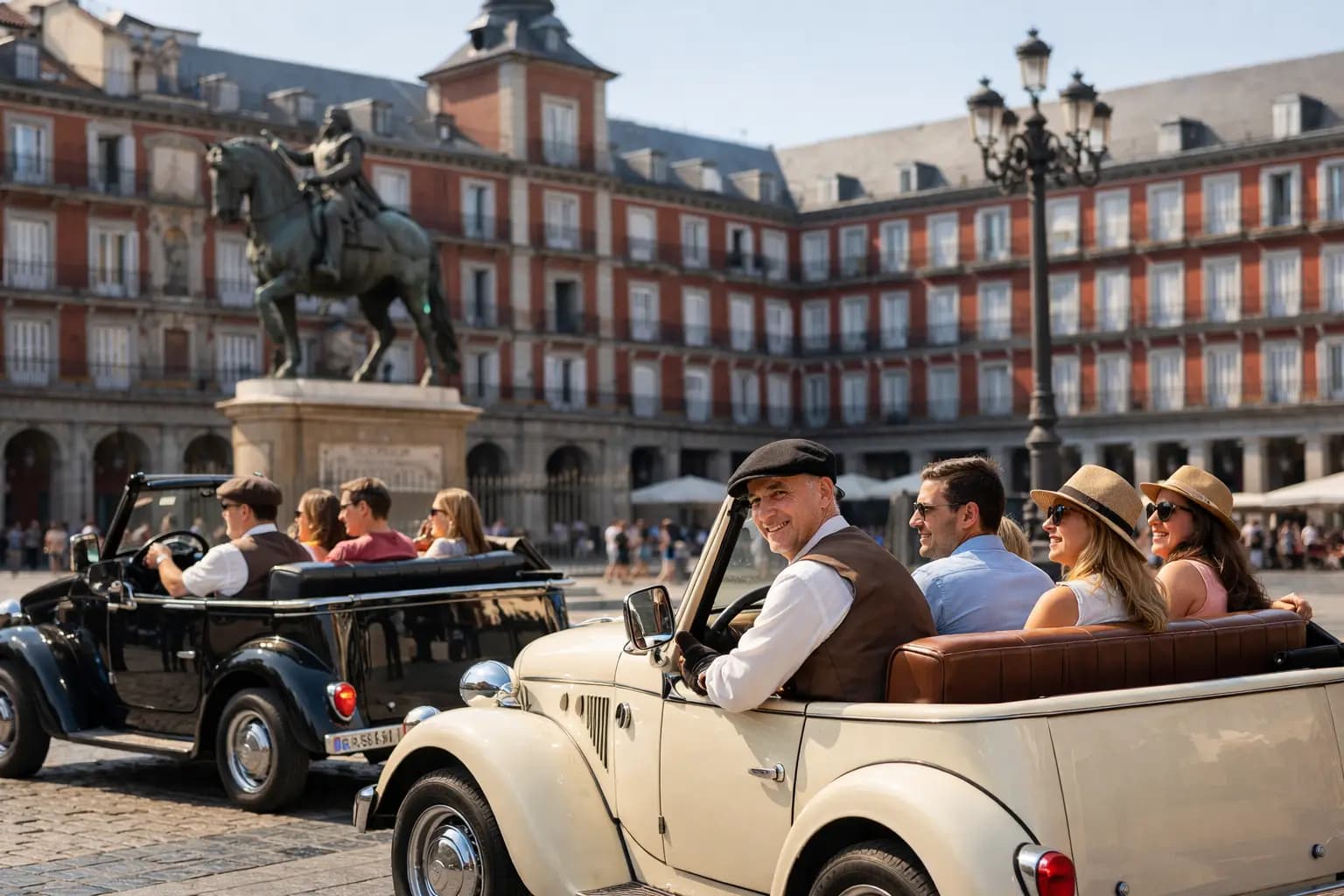
A guide to Madrid de los Austrias for private, elegant discovery: royal squares, hidden lanes, quiet courtyards, and the best time to visit at leisure.
A wrought-iron balcony above a narrow stone street, the hush of a chapel just beyond a lively square, a palace facade catching the late-afternoon sun: this is the Madrid held within a guide to Madrid de los Austrias. It is the city’s old royal heart, best appreciated without rushing from monument to monument. Here, the pleasure is in arriving well, looking closely, and allowing the streets to reveal their character.
Madrid de los Austrias takes its name from the Habsburg dynasty, which made Madrid its capital in 1561. The neighborhood retains the intimate scale of that era. Its lanes were laid out for carriages, courtly errands, market life, and processions - not modern schedules. For travelers accustomed to grand European capitals, it offers something particularly rare: royal history that still feels inhabited.
Why Madrid de los Austrias Deserves Your Time
This quarter is not a museum district preserved behind glass. Residents pass through Plaza de la Villa on their way to lunch. Bells mark the hours near Calle Mayor. Families, diplomats, and travelers cross paths in Plaza Mayor, where arcades frame one of Spain’s most recognizable urban scenes.
The area is compact, but it should not be treated as a quick stop between larger attractions. A walking visit can be rewarding, especially early in the morning, though its uneven paving and dense streets can become tiring in the heat or during peak hours. A private panoramic journey offers another kind of luxury: the ability to take in the neighborhood’s atmosphere from the comfort of a beautifully appointed vintage car, then step out only where the view, story, or photograph is worth lingering over.
The distinction matters. Madrid de los Austrias is full of details that disappear when you are following a raised umbrella or trying to keep pace with a large group. A private experience leaves room for a favorite facade, a spontaneous coffee, or a quiet detour toward a lesser-known square.
A Guide to Madrid de los Austrias: The Essential Stops
Plaza Mayor: Madrid’s Grand Outdoor Salon
Plaza Mayor is the natural starting point, though it is most memorable when approached rather than simply entered. The surrounding streets create a sense of anticipation before the vast, enclosed square opens in front of you. Commissioned under Philip III and completed in the early 17th century, it has hosted royal celebrations, markets, theater, and darker public spectacles over the centuries.
Today, its red facades and slate spires offer one of Madrid’s defining views. The equestrian statue of Philip III sits at its center, while the Casa de la Panadería lends the square its painted, storybook presence. It can be busy at almost any hour. For a more refined experience, visit in the morning before the terraces fill, or near sunset, when the architecture softens and the surrounding streets begin to glow.
A word of discretion: the most prominent terrace is not always the most memorable meal. Plaza Mayor is ideal for atmosphere and a glass of wine, while the neighboring streets tend to offer a more intimate table.
Calle Mayor and Plaza de la Villa
From Plaza Mayor, Calle Mayor traces a historic route toward the Royal Palace. This is not a street to hurry along. Look upward at the balconies and carved stonework, then pause at Plaza de la Villa, one of the city’s most graceful medieval corners.
Here, three centuries of architecture sit together with remarkable ease. The Casa y Torre de los Lujanes, with its brick tower, is among the oldest civil buildings in Madrid. Nearby, the former City Hall carries the more formal presence of the 17th century. The square feels notably quieter than Plaza Mayor, particularly in the late morning, and makes a beautiful setting for photographs that feel distinctly Madrid rather than generically European.
Mercado de San Miguel: A Polished Pause
Just beside Plaza Mayor, Mercado de San Miguel is an elegant iron-and-glass market hall where Spanish ingredients are presented with theatrical flair. It is a convenient stop for oysters, jamón ibérico, sparkling wine, or a small taste of regional specialties.
Its popularity comes with a trade-off. The market is often lively, and it can feel crowded at lunch and early evening. For guests who value calm over spectacle, a brief late-morning visit is preferable. Those seeking a lingering, private meal may be better served by reserving a table elsewhere and treating the market as a visual interlude rather than a dining destination.
The Royal Palace and Almudena Cathedral
Continue west and the streets begin to open. The Royal Palace rises with unmistakable grandeur, its pale stone facade overlooking the broad expanse of Plaza de Oriente. Although the Spanish royal family does not live here, the palace remains an official residence used for state occasions and ceremonies.
The scale is magnificent, yet the best perspective is often from outside. Plaza de Oriente provides a composed view of the palace, gardens, and statues, while the nearby Sabatini Gardens add symmetry and stillness. Across from the palace, Almudena Cathedral offers a more recent but compelling counterpoint. Its interior is unexpectedly contemporary in color, and its dome provides one of the area’s finest elevated views when access permits.
If time is limited, choose according to your interests. Palace interiors reward travelers drawn to ceremonial rooms, collections, and royal history. For architecture, photography, and an unhurried afternoon, the exterior sequence of palace, gardens, cathedral, and nearby viewpoints may be the more satisfying choice.
The Hidden Edges: Las Vistillas and Calle del Codo
The most memorable moments in this neighborhood are often found just beyond its headline sights. Calle del Codo, a narrow bend near the old city center, carries the atmospheric compression of old Madrid: stone, shadow, and an almost cinematic sense of passage. It is a small moment, but one that reveals why the neighborhood needs time.
For a wider view, Las Vistillas sits at the southern edge of the historic quarter. Its gardens and terraces look toward the Casa de Campo and the western horizon. At sunset, the city’s rooftops unfold in layers, and Madrid feels less like a capital of grand avenues than a place built on light, conversation, and long evenings.
The Best Way to Experience the Old Royal Quarter
The ideal visit depends on the kind of Madrid you want to remember. Independent travelers may enjoy wandering with no fixed plan, especially in winter or on a mild weekday. Yet the neighborhood’s charm can be diluted by crowds, summer heat, and the practical challenge of connecting its key sights without losing the thread of the story.
For couples, celebratory trips, and guests who prefer privacy, a tailored route creates a more graceful rhythm. Begin with a private pickup from your hotel or preferred central address, glide through the surrounding boulevards, and arrive at the historic center with context already in place. A classic car is particularly well suited to this part of Madrid: it echoes the neighborhood’s sense of occasion while offering a rare visual contrast against the city’s stone facades.
Retro Tour Madrid can shape such an experience around your interests, whether that means royal history, architecture, fine dining, quiet photo stops, or a route that continues into La Latina, Barrio de las Letras, or the leafy avenues near Retiro. The destination need not be predetermined. A memorable afternoon might end at an exceptional restaurant, a rooftop for aperitifs, or wherever the city feels most inviting.
When to Go and What to Notice
Spring and fall offer the most comfortable conditions for Madrid de los Austrias, with clear light and temperatures that invite lingering outdoors. Winter has its own appeal: fewer crowds, crisp evenings, and a more intimate atmosphere in the old streets. Summer is best reserved for early morning or after the day’s heat recedes.
As you move through the quarter, pay attention to transitions rather than checking off landmarks. Notice how the broad ceremonial spaces around the Royal Palace narrow into older lanes; how formal Habsburg brick gives way to the pale stone of later Madrid; how a busy arcade can lead, within a minute, to an almost silent courtyard. Those contrasts are the real luxury of the neighborhood.
Leave room for one unscheduled pause. In Madrid de los Austrias, the finest discovery is often not the palace or the famous square, but the moment when a quiet street, a beautiful car, and the late Spanish light make the city feel entirely your own.
¿Listo para explorar Madrid en un Ford T?