
See the top Madrid cultural landmarks with a more intimate eye, from royal squares and great museums to sunset views, gardens, and quiet old streets first.
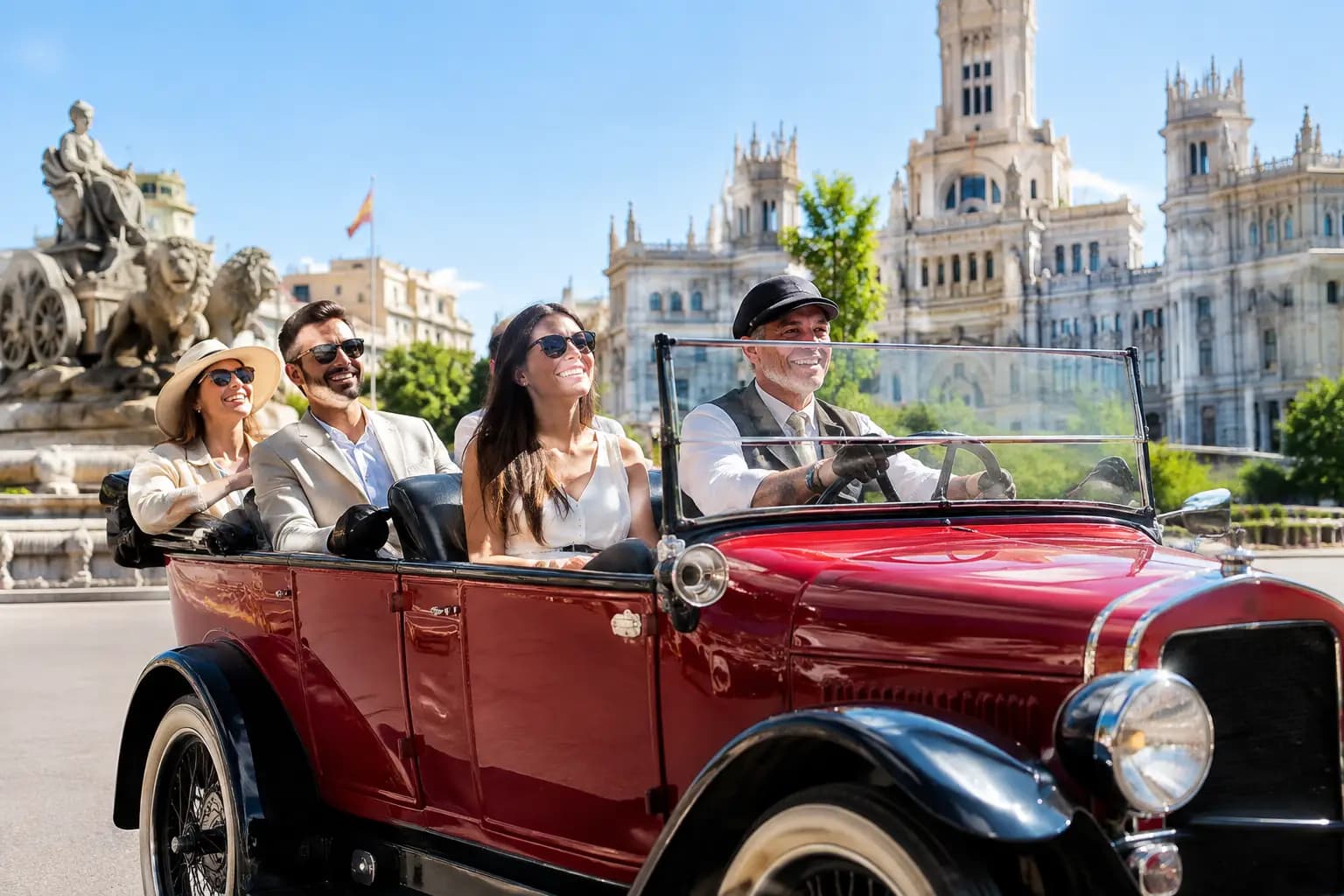
Madrid is most convincing when it is not rushed. The top Madrid cultural landmarks are not simply places to tick off between reservations. They are settings for arrival: a grand palace façade in morning light, a shaded garden after lunch, a golden temple at dusk, and a theatrical avenue seen from the quiet comfort of a classic car.
For travelers who value privacy and a sense of occasion, the city reveals itself in layers. A thoughtful route can place Madrid’s most celebrated monuments beside the intimate streets and overlooked viewpoints that give them context. These are the landmarks worth seeing with time, style, and room to savor the view.
1. Royal Palace of Madrid and Plaza de Oriente
The Royal Palace is Madrid at its most ceremonious. Its vast white-stone exterior, formal courtyards, and commanding position above the old city speak to the scale of the Bourbon court. Even for guests who prefer not to spend hours inside, the approach itself is memorable: the palace opens onto Plaza de Oriente, where clipped gardens, sculptures of Spanish monarchs, and the elegant façade of the Royal Theatre create a composed urban scene.
The best experience depends on your priorities. The interior offers an impressive collection of state rooms, tapestries, and chandeliers, but it can be busy in high season. For a more unhurried impression, admire the palace from the square, then continue toward the Sabatini Gardens or the nearby royal viewpoints. Early morning brings softer light and fewer people. Late afternoon adds a warmer, more cinematic character to the stone.
2. Plaza Mayor and Madrid de los Austrias
A few minutes from the palace, Plaza Mayor feels less like a monument than a stage set that has remained in use for four centuries. Its red façades, arcades, and graceful symmetry belong to Madrid de los Austrias, the historic core shaped during the Habsburg era. There is always movement here, but the square’s real pleasure lies in noticing the details: iron balconies, archways framing passing figures, and the shift in atmosphere as daylight fades.
The plaza is best understood as part of a wider neighborhood rather than an isolated stop. The streets around it lead to medieval passages, traditional taverns, and small churches whose façades can easily be missed on a standard itinerary. This is where a private, flexible route earns its value. You can pause for photographs, take an unexpected detour, or simply enjoy the old city without being carried along by the pace of a large group.
A note on timing
Plaza Mayor has an energy at every hour, but its character changes considerably. Mornings are more serene. Evenings are livelier and especially appealing before a dinner reservation in the historic center. Travelers seeking a quieter, more refined moment may prefer to view it from the surrounding streets before returning later for the atmosphere.
3. Puerta del Sol and the pulse of the capital
Puerta del Sol is not Madrid’s most beautiful square, yet it is one of its most essential. This is the symbolic center of Spain’s road network and the city’s daily rhythm. The famous clock tower marks New Year’s Eve for millions of Spaniards, while the bronze Bear and Strawberry Tree sculpture remains a modest but unmistakable emblem of Madrid.
It is a place to pass through with purpose rather than linger for long. Sol connects the stately city to the commercial one, and its surrounding streets show how naturally Madrid moves between heritage and contemporary life. A well-designed itinerary might approach from the graceful streets of Barrio de las Letras, make a brief stop here, then continue toward Gran Vía or the more intimate lanes of the old center.
4. The Prado Museum and Paseo del Arte
The Prado is one of the world’s great museums, and it deserves more than a hurried visit. Velázquez, Goya, El Greco, Rubens, and Bosch are not merely names on a checklist here. Their works create a journey through Spanish and European power, faith, beauty, and imagination.
The trade-off is simple: a full museum visit requires time and focus. Guests with a deep interest in art should reserve at least a few hours and choose a small number of galleries to appreciate properly. Those who would rather preserve the pace of a day in Madrid can admire the neoclassical building from outside and take in the broader cultural landscape of Paseo del Prado, where the Thyssen-Bornemisza Museum, the Reina Sofía, and the grand boulevards form an exceptional artistic district.
The exterior is particularly elegant in the late afternoon, when the avenue’s mature trees soften the city around it. It is a natural transition between a museum visit and a drive toward Retiro Park.
5. Retiro Park and the Crystal Palace
Retiro is where Madrid exhales. Once reserved for royalty, this expansive park is now a favored refuge for residents and visitors who want a quieter encounter with the city. Its broad paths, sculpted greenery, and ornamental lake offer a gentler counterpoint to the formality of the palace district.
The Crystal Palace is the park’s visual centerpiece. Built in the nineteenth century with glass and iron, it catches the changing sky and feels almost weightless among the trees. Nearby, the lake and the Monument to Alfonso XII provide one of Madrid’s most recognizable compositions, particularly in the early evening.
Retiro rewards a measured visit. A quick drive around its perimeter can reveal its scale and position within the city, but the park itself asks for a stroll. It is ideal after a long lunch, before an evening engagement, or whenever the itinerary needs a moment of calm without sacrificing beauty.
6. Gran Vía and the city’s architectural drama
Gran Vía is Madrid in full performance. Built in the early twentieth century, its procession of ornate façades, domes, theatres, hotels, and department stores reflects a city eager to join the great European capitals. The architecture is bold rather than restrained, which is precisely its charm.
Traffic and crowds are part of the experience here, so it is not the place for a long pause. Yet viewed from a classic car, Gran Vía becomes wonderfully cinematic. The façades rise above the movement, and famous corners such as the Metropolis Building and the Capitol Building appear in their intended scale. After dark, the illuminated street has a distinct old-world glamour that suits a celebratory evening in Madrid.
7. Barrio de las Letras and the literary Madrid
For a more intimate cultural landmark, look to Barrio de las Letras. This is the quarter associated with Spain’s Golden Age writers, including Cervantes, Lope de Vega, and Quevedo. Its streets are lined with literary quotations set into the pavement, but the neighborhood’s appeal is more atmospheric than museum-like.
Here, Madrid feels personal. Elegant townhouses, discreet cocktail bars, galleries, and small plazas create an easy conversation between past and present. The Casa de Lope de Vega adds historic substance, while nearby Santa Ana Square is perfect for watching the city settle into the evening.
This neighborhood is especially rewarding for couples and returning visitors who have already seen the headline sights. It offers cultural depth without demanding an agenda, and it pairs beautifully with a private route that includes a hotel pickup, an unplanned photo stop, and a final drop-off at a favorite restaurant.
8. Temple of Debod at sunset
The Temple of Debod is one of Madrid’s most surprising sights: an ancient Egyptian temple overlooking the western edge of the city. Gifted to Spain in the 1960s and reconstructed in Parque del Oeste, it carries a quiet grandeur unlike anything else in the capital.
At sunset, the temple becomes a destination in its own right. The water around it reflects the stone, the sky opens toward the Sierra de Guadarrama, and the city’s rooftops take on a soft amber tone. It can be popular, particularly on clear evenings, but there is space nearby to find a more private angle.
For many visitors, this is the ideal final scene. It is contemplative, photogenic, and just removed enough from the central streets to feel like an escape. Retro Tour Madrid can shape a private classic-car route around this kind of moment, allowing the day to end wherever it feels most fitting: at a rooftop table, a quiet hotel entrance, or one last view over the city.
Madrid’s cultural landmarks become more meaningful when the spaces between them are given equal attention. Leave room for the changing light, a pause in a hidden square, and the pleasure of arriving somewhere beautiful with no need to hurry.
Ready to explore Madrid in a Ford T?